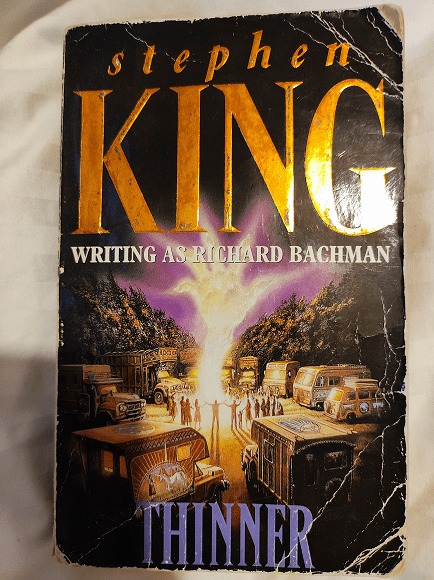
Buy Thinner from Bookshop.org
Rating: 3 out of 5 unsettling pies

Preview (i.e. no spoilers)
This is one of King’s Bachman outings, and you know it pretty much out of the gate. Bachman books specialise in anti-heroes, and there ain’t a likeable toe on the foot of this book. In some novels, that might put you off it completely, but given that the main thrust of this book is bad things happening to bad people, it actually works very nicely. Sure, it’s a pulpy morality tale, but as long as you recognise that, you can still enjoy the ride.
That said, there is a note of true discomfort that runs throughout the book, which is its lens on travellers (or as the book calls them, gypsies). I think many communities still call themselves gypsies, and certainly at the point of his writing this, I don’t think it had developed into a contentious word, so we can give him a pass on that – but while he tries to reveal many stereotypes for what they are, King nevertheless falls into the magical other trap he’s so well-known for stumbling into face-first. The whole book is predicated on the idea of a gypsy curse, which is a major feature in the mythos used to stereotype and reject travellers.
If you can get past that, though, this is a rather fun romp of lashings of misery for the deserving all around, at a whippy pace.
Review (i.e. sparing the rod and spoiling it all)
It’s a shame that King does get hoist by the cultural petard of a gypsy curse, because actually he does a lot to defend travellers in this book. As much as anything, it’s an examination of that Favourite King Theme, the small town syndrome, and the small-minded facsimile of community that it brings. When Billy kills a gypsy woman, it’s the town closing ranks to acquit him that is the truly evil act. And even if in response, the curse is an evil thing to respond with, there’s a spirited defence on behalf of Lemke that the reader does sympathise with. The law can’t be trusted to protect the travellers – towns profit from them for a few days and then illegally force them to move on. By being ousted physically and emotionally, it forces them to close ranks and enact their own justice.
What I think is really neat is the ending. It couldn’t just have Billy successfully lifting the curse and living happily ever after – nobody needs another story of whitey wins. But equally by the endpoint you do want the curse lifted, because it’s been the ticking timebomb throughout the book, and to simply fail to disarm the nuke would be a very unsatisfying resolution. And so, enter the spooky pie.
King is brilliant at bringing in set-pieces that are instantly memorable, frankly bizarre and yet which somehow work within the context of the story. Who would have approved Christine on the premise that it’s a, kind, spooky, sexy car? Who would have thought that The Long Walk would have been so fantastic, given that it’s basically about a… well, a really long walk? Who would have ever given credence to someone being battered to death by a possessed Coca-Cola machine? In this same rich vein of King Nonsenses, the cursed wibbly-wobbly pie is a beautiful and ridiculous thing.
Of course, it comes down to coincidence in the end, which is a nice mirror to the initial set-up. It was a coincidence that Billy’s wife was gearstick-grabbin’ at the time the old woman stepped into the road, and yet that coincidence took Lemke’s daughter from him. And in turn, it’s a coincidence that Billy’s daughter came back to a delicious-looking (if obviously full of fucking blood) pie and ate it while he was asleep, and it took his daughter from him. The difference is that Lemke had someone else to blame, whereas Billy could finally – after spending the entire length of the book blaming everybody but himself for his own unintentional weight-loss regime – only look inwards for guilt.
 Read Everything By