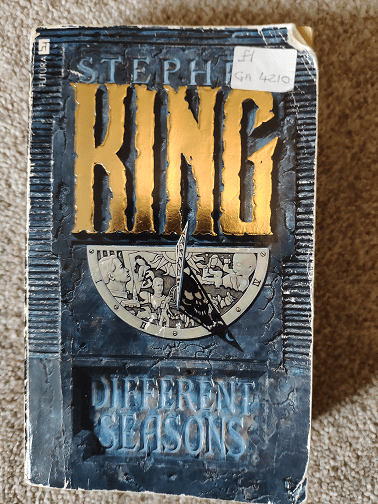
Rating: 4.5 out of 5 all-American teenage Nazis
Buy Different Seasons from Amazon here.
Buy Different Seasons from Bookshop.org here.
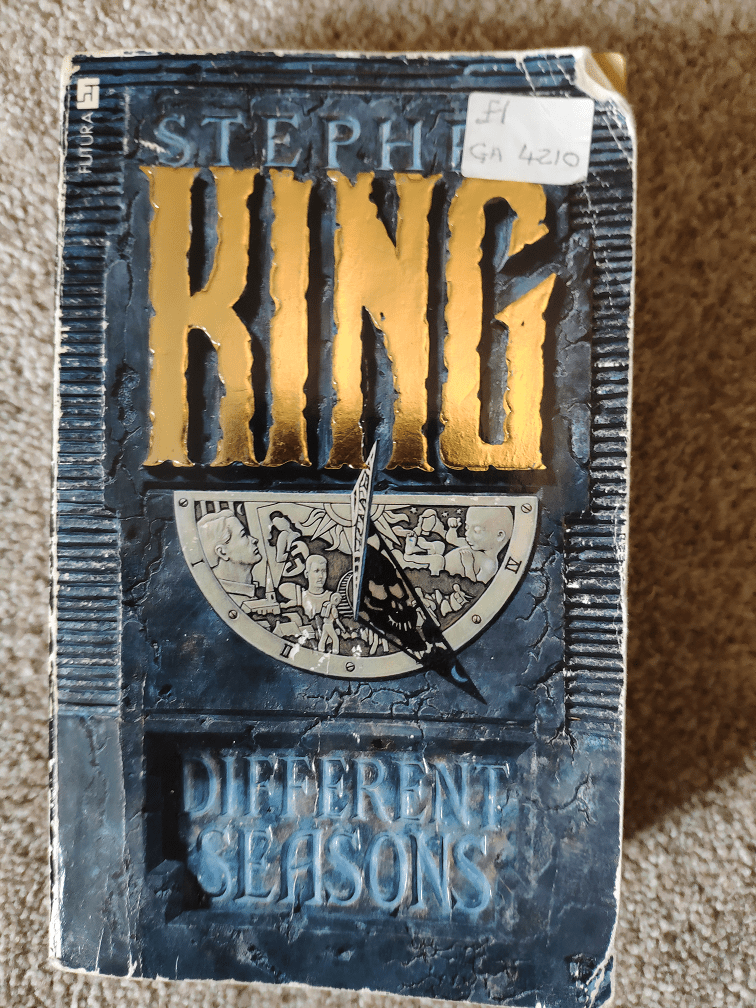
Preview (i.e. no spoilers)
What can I say about Different Seasons? It’s a collection of four novellas, three of which have been made into films (the final fourth is now apparently in the works), and two of those are revered as among the best films of all time. They achieved that, in large part, by sticking closely to the stories. So it’s fair to say that it’s a pretty excellent collection, although the notion of ‘seasons’ feels a bit thrown together and, to be honest, non-existent. Hey Bill, what’s a combination of four things that I could name this after? Seasons? Okay sure, whatever, more coke please.
It’s also a good argument for the novella as a form of writing. Publishing houses tend to disdain the novella as hard to sell, preferring to either collect short stories or sell full-length novels, but that does the novella poor justice. It’s a great length to explore a single idea at length, to flesh it out with more incidents and thematic ideas, without the author having to bloat it beyond its useful length. A worm is a worm – you shouldn’t have to jam a bicycle pump in its mouth to try to sell it to the snake market.
Most of these stories are not paranormal – this is King trying to step away from horror a little, although the stories have their horrific elements regardless. But they’re about human nature, the good and the bad, and his observations are as keen as a starving dog outside a butcher’s on International Sausage Day.
This ranks up there with his very best, I would say.
Review (i.e. they spoil you up, your mum and dad)
I’ll go into the individual stories one-by-one below, but my overall summary is: three knock-out stories and one okay one. If the book had only contained the first three, I’d be giving this the full no-joking 5 stars and it would be (so far in my read-o-rama) second only to The Shining.
Rita Hayworth and the Shawshank Redemption
At its heart, this is a story about hope and determination. The former keeps the latter alive; the latter eventually justifies the former. It shares with The Body a sense of perseverance against the petty selfishness of people with a modicum over power over others, and has a much more uplifting outcome in that.
In a way, we’re all given a chance to be Andy Dufresne, which gives this story a universality that is very appealing. We’re not all born with success thrust into our laps like lazy poodles, but we all have the ability to chip, chip, chip away over a number of years until we succeed at something worthwhile. Life will always give you plenty of reasons to dim that vision – in this story’s case, corrupt wardens and gang-rapist fellow prisoners are wielded to painful, ugly effect – but if you can keep that fire burning, you’ll always have everything to gain. This is a genuinely uplifting story, and perfectly plotted – the big reveal came as a genuine surprise to me (although you can never discount the possibility that I am Idiot Of The Year 34 years running and that it says more about me than the story), and all along the way the little vignettes that build up the character of Dufresne and Shawshank Prison itself are satisfying in-and-of themselves.
Apt Pupil
You jump out of the story of the best that human nature can offer and straight into the worst. Apt Pupil is a brutal, ugly and brilliant story – a troglodyte carved out of the finest marble, studded with diamonds and Yorkie bars. The mutual parasitism between Todd and Dussander really is written exquisitely, and it’s brilliant how he reflects psychological damage physically – by glutting themselves on a diet of evil, they receive no nourishment and physically as well as mentally deteriorate.
Making the main character an all-American schoolboy was a fantastic choice. It pokes at the idea that ‘this could never happen here’ and exposes that we are all susceptible to the darker side of human nature.
True, having Heisel, a former prisoner-of-war under Dussander’s watch, end up in the same hospital room as him is a bit of a stretch. But the rest of the book is so believable, you can forgive it. Well, I can. It might drive you apoplectic, but if it does, you probably have bigger issues to worry about than an over-convenient plot device.
I will say that there are references to some truly abhorrent real-life Nazi practices in this that are extremely upsetting. The horror in this story comes from what real people were – and are – able to perpetrate onto other real people, and how that can degrade the soul. But I wouldn’t read it if you’re not up to reading about that stuff.
The Body
King loves a coming-of-age story, and this is probably his finest articulation of it.
While there are lots of moments of comedy in this, both in support and at the expense of the boys, the main emotion you feel is a sense of slight sadness. It’s not a perfect story – there really doesn’t feel like much reason for including Stud City, LeChance’s terrible first published short story, and that’s a bit of a slog to get through – but it really hits the melancholic nostalgia bone with a fucking great mallet.
As well as you never really have friendships like you did when you were 12, do you? the main takeaway seems to be that there’s no such thing as happy endings where everything gets tied up with a neat bow and a kiss for good measure. Life doesn’t work that way. You can just do your best to be the best person you can be, and sometimes that’ll see you through, and other times you’ll get kicked in the painbags for your trouble. So try to cherish the true moments of happiness and friendship that you find along the way. Also, don’t write angsty short stories where you’re the thinly veiled protagonist (although obviously that is something King is literally doing in this story, so maybe that’s not one to take away, given its success).
The Breathing Method
There’s a lot of good stuff in this story, but off the back of the other three, it can’t help but be a slight deflation. The frame story, which seems to be an homage to the Chowder Club in Peter Straub’s Ghost Story (this story is even dedicated to Straub and his wife), just goes on a little too long and in too much depth. By the time you actually get to the meat-and-potatoes of the main story, you’re starting to get the metaphorical itchy feet, and although that sub-story is then good enough to act as stretching-the-metaphorical athlete’s foot powder, some of the readerly motivation is lost.
The other thing is that all the other stories in this collection live with you after you’ve read them – they have stuff to say and ruminate upon, and so does The Breathing Method, but to a much lesser extent. You do genuinely care about Sandra and her life, but despite all her struggles, she still dies. Yes, the grit she demonstrates in life still helps her to reach her goal of giving birth even after death – but you’re sort of left with a so what?.
I am generally totally on board with King’s ethos of a good story can just be a good story, without needing to have a high-falutin moral or message attached, but when you’ve just read through three excellent novellas that are saturated with insight and strong messages, this couldn’t help but fall a little flat. I think it’d have been better to include it within a short story collection than here.
 Read Everything By
One thought on “Different Seasons (1982)”