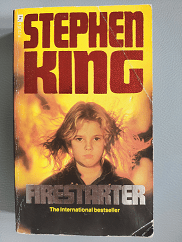
4.5 out of 5 racially questionable villains
Buy Firestarter on Amazon here.
Buy Firestarter on Bookshop.org here.
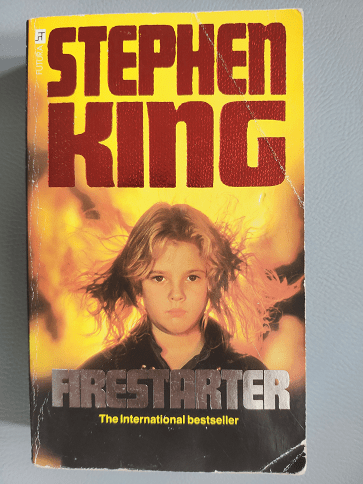
Preview (i.e. no spoilers)
Look, the fastest way to know whether you’re into Firestarter is: Are you into Stranger Things? Because if you are, you’re almost certainly into Firestarter. The Jonas Duffer Brothers took a tremendous amount of inspiration from it when creating their Netflix 80s-o-rama, and an awful lot of the stuff that makes Stranger Things good is the same stuff that makes Firestarter good.
It’s a speedy little number, balancing the inherent at-a-run pace of an escape thriller with the vicarious excitement of people getting to use magic powers. I honestly don’t know what more you’d want from it. Oh, you’d also like shadowy government agencies conspiring against underdogs? Yeah, it’s got that too. READ IT.
Review (i.e. tick tock, tick tock, it’s spoiler o’clock)
There are many ingredients that combine to make this a delicious read. That’s right, I started with a recipe metaphor, which is Imagery 101. It’s not going to get any better either.
One, as I’ve gone on and bastard on about in my review of The Dead Zone, is this superb tension between Andy’s need to use his ‘push’ and the very real danger that each time could be the one that explodes his brain like a jelly piñata. As he physically deteriorates across the book, it ramps up the stress perfectly. When you counterbalance that with the book’s clear journey towards Charlie finally taking the brakes off and trying her own powers in all their destructive glory, you get two opposing-but-related forces acting as countdown timers. It keeps the pace snappy, and makes the book harder to put down.
This is the first King book to introduce The Shop – not the CIA or the FBI but a shadowy secret government offshoot that, at first, seems to have carte blanche to destroy people’s lives on a be-sunglassed whim. Given this was written around the time that the MK Ultra project was uncovered, it doesn’t feel like a huge leap from what was actually happening. So far, so paranoically good. But what elevates that is the fact the The Shop are… really somewhat incompetent. They don’t have carte blanche, they have a series of fuck-ups that they’re trying to cover up, and hoping their bosses don’t notice in case they get their budget cut, or the whole gig shut down. It lends an edge of – sometimes comic – realism that sands off some of the rougher edges of conspiracy gubbins.
Rainbird is less believable, but it’s a bit hard to care because he’s just such a good villain. His weird love obsession with Charlie, with death swapped in for sex, is deeply unnerving, and combining that with his chilling competence and disdain for humanity creates the perfect antagonist. For a chunk of the book, you think The Shop are the bad guys – but they’re really just sort of banal evil; Arendt-boys. Rainbird is the one whose heart pumps ice water instead of blood.
The only issue with Rainbird is his provenance – there’s an element of me heap big Injum in his backstory that just doesn’t ring true. King has been accused of redface in this character, and it’s hard to disagree to a point. I believe in the right of all sexes and nationalities to get to play a wicked-evil villain, so it’s not that he’s the bad guy – just that when he discusses his heritage, it comes across as a white person who’s watched too many Westerns writing it.
Where he is squarely in Comfort Town, though, is writing rural white characters, and Irv and Norma Manders are a fantastic example of the rough-but-kind strangers. This is a book about desperation, and the Manderseses represent hope in humanity. Even after Charlie destroys their farm, they take her in and watch over her. It’s the common man against the government, something that we tend to see more in Bachman books than King ones, but it’s a card very effectively played here.
Overall, it’s a flaming good book, with a burning pace and a, um, fire and stuff.
 Read Everything By