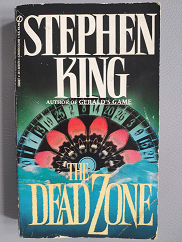
Rating: 4 out of 5 maniacal politicians
Buy The Dead Zone from Amazon here.
Buy The Dead Zone from Bookshop.org here.
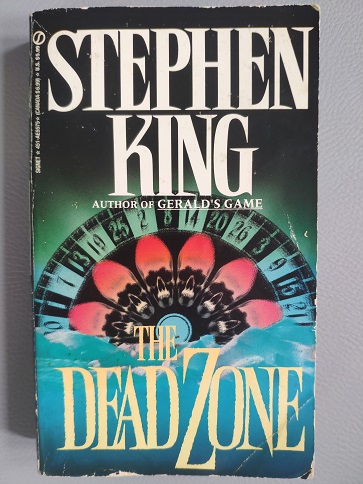
Preview (i.e. no spoilers)
Coming to The Dead Zone, I have to admit my expectations were unusually low. Judging a book by its title, I felt it sounded a bit too on-the-nose pulp horror, like Spooky Ghost Murders or Cannibals Gone Wild. But Mr. King confounded my expectations and by the end I was racing through the book like a bad analogy through a goose. It feels much more like a thriller than his previous books, with tension pulled taut as a hypochondriac’s doctor. It’s snappily paced.
It does contain some pretty grim murders, only a couple of which are described in much detail but just a heads-up. Of course, most King books feature some sort of horrible death, but these are specifically rape-murders – so if that’s likely cause you significant distress, you might be better off with Firestarter, which has the same thrillery pacing but is sexual assault-free.
Review (i.e. Spoilers, spoilers everywhere and not a plot to sink)
By this point it should be very clear that Stephen King is really into ESP. I think I’ve read interviews that say he doesn’t necessarily believe in it, but he’s into the theory of it, and he’s interested in the experiments the US government were running on it, starting in the 50s, reaching its height in the 1970s with Project Sun Streak but continuing right up until the conclusion of Project Stargate in 1995. In 1975 the CIA formally, and with equal parts pomposity and stupidity, concluded: “A large body of reliable experimental evidence points to the inescapable conclusion that extrasensory perception does exist as a real phenomenon.” So it’s really not surprising that King would take that and run with it in his fiction – most directly in Firestarter, but elements of it feed into most of his stories, including The Dead Zone. More inexplicable powers than an X-Man trapped in a sackful of radioactive spiders.
I’ve got one more Firestarter comparison to get out of the way, and then it’s all TDZ, honest. I really enjoyed in this how Johnny, the main character, seems to have sustain damage from using his “gift”. It’s more explicitly explored in Firestarter, but the idea that Johnny has to strike a balance of how often he uses his talents against the permanent and possibly fatal damage it causes him, really adds an extra level of tension to the story. People talk about a narrative device called “the clock” – an element of pressure in the story that acts as a driving force for the characters to compete against. The clock in The Dead Zone is that Johnny has to use his talents to prevent the world ending, but in doing so he brings his own personal ending closer each time. It’s really clever and effective, which is presumably why King took that and later ran with it in Firestarter.
The Dead Zone feels almost like two separate stories woven into one. The first is [massive spoiler here, so seriously don’t read on if you’re spoiler-shy] catching the serial rapist-murderer Frank Dodd. There are little vignettes of someone being seriously awful, and until Dodd kills himself, you might think it’s all the same person – so it almost feels like, with his reveal and death, you reach the end of the story, halfway through the book. It’s only when Greg Stillson continues to be a complete monster that you realise that Dodd wasn’t the one who kicked the dog to death in the beginning, and that catching Dodd was really just a warm-up for Johnny, a prelude to the main event of saving the heck-dang world.
So the question the book asks us changes partway through, from If you were psychic, would you use it to stop murderers even if it ruined your life? to if you were psychic, would you stop Hitler before he rose to power, even if it killed you too? Which could be clumsy, but is actually really neatly done. It’s like a smooth gear change up, rather than clunking the clutch and stalling the engine.
It feels impossible to write a review of The Dead Zone without mentioning the political premonition King himself had, in that Greg Stillson feels a hell of a lot like a certain Tango-coloured ex-president. Populist, willing to say and do whatever it takes to achieve power, even running on a ticket of clearing out the rot from Washington while running a campaign that was itself Rotterdam-central. Having lived through that panicky sense of having an overcaffeinated chimp left in a room with the big red nuclear button, I can attest that King captured it perfectly here, about 40 years ahead of his time.
There is a lot of American politics in this novel, particularly relating to Vietnam, and I’m pretty sure more of it went over my head than US planes went bastardly over Vietnamese jungle. The underlying tension in the novel is the loss of faith in politicians and the ideological fall-out between the young and the old; the hawks and the doves. When Johnny wakes from his four-and-a-half year coma, suddenly people are growing their hair long and spitting at the government. Stillson is an opportunity exploiter. When politics starts to feel so morally corrupt that it becomes a joke, people are apt to elect a clown. Boris Johnson is evidence enough for this. And when the greasepaint comes off and it turns out underneath the clown make-up was a rabid badger all along, it’s often too late to change course.
So ignoring the fact that there are probably loads of references to the US political system and climate of the 1970s that I, as winner of 2021’s Mr Dunce competition, not only didn’t understand, but probably didn’t notice – I thought this was a rip-roarer of a book, and well worth your time.
 Read Everything By
2 thoughts on “The Dead Zone (1979)”