
Rating: 5 out of 5 blistered feet
Get The Long Walk on Amazon here.
Get The Long Walk on Bookshop.org here.
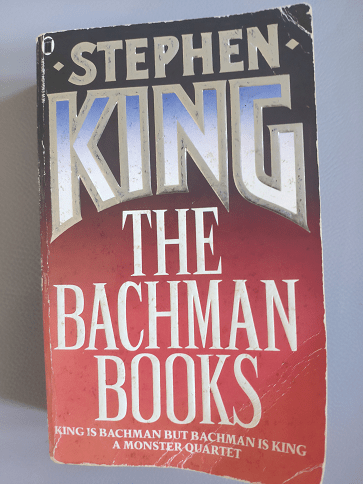
Preview (i.e. no spoilers)
Richard Bachman differs from Stephen King in a few ways. His early books, at least, feature no paranormalignancy, and are instead focused on psychological grit, often in a dystopian setting. He’s also flexing different inspirations for the voice and writing style – less Lovecraft, more Vonnegut; less Koontz, more Bradbury. It’s a voice very deliberately patched together from other influences.
He exercises the best of this Bachmanstein’s Monster in this story. It’s honestly brilliant, if somewhat depressing.
If you’ve seen The Running Man (the Arnie vehicle film) or the original Robo-Cop, you’ll probably like this – not because they’re similar plotwise, but they’re tonal relations.
Review (i.e. buy one spoiler, get ten free)
The most impressive thing about The Long Walk is how King maintains and ratchets up tension in a story that is essentially about, well, a long walk. It feels almost unbearably punny to discuss the pace, and that’s come from me, the Punmaster General. But it is genuinely something to behold. From the relatively easy start, through the long nights and slow descent into raw insanity, King chronicles the characters’ mental dissolutions so carefully and gently that you don’t feel you’re an observer but along for the ride. And that ride is called Heart Of Darkness, USA-Style. USA! USA!
The nuts and bolts of the dystopia in which this takes place are never clarified – you get hints of it through conversation and the thoughts of Ray, the main character – but it never fails to feel complete. Essentially a similar world to this one, with a few knobs turned up to allow for an annual ‘game’ that sees young boys shot to death in front of baying crowds. King implies the impact of national poverty with clarity, along with that of martial law. It doesn’t feel real to now, but it does feel realistic in potentia.
The good thing about a character-set of all young boys is that you’re immediately set up to empathise with them – they’re too young to understand the ramifications of what they do and say, which is often redemptive when they talk about fighting or objectify women. They don’t know better, and they’ve never been encouraged to. In many ways, it’s a book about masculinity and how it pulls boys onto that particular grim treadmill, then cranks up the speed. That does mean that there aren’t many laughs to be had, but King does his best to shoehorn a few in, like a humour-cobbler fitting a particularly severe pair of dress shoes.
Sure, there’s enough cod psychology in here to keep a marine shrink very well-off, but also some very satisfyingly well-observed notes on human nature. And, of course, it’s a book about hope, death and the death of hope. (Also ‘charley horses’)
It feels like there are certain parallels, too, with the Vietnam war. In the same way as draftees were selected on national television through a ball-based lottery, so too are the Long Walkers picked. The ever-present celebrity of The Major lends a certain martial tone to the whole affair. And, of course, the reality of being a Long Walker is very different to the glamour that seemingly surrounds it, much as US soldiers discovered the leprechaun gold of triumphant masculinity melted away in the Vietnamese morning like so many trees under napalm hits.
In a wider sense, though, we’re all on the Long Walk. And the best thing you can do is surround yourself with people to make that easier, because the end is always the same – if we’re all going to die alone, better to live together.
 Read Everything By
Love your writing Tom !
Great new site …
LikeLike
Thanks, Deb!
LikeLike