
Rating: 4.5 out of 5 infectious bloatnecks
Buy The Stand from Amazon here.
Buy The Stand from Bookshop.org here.
Preview (i.e. no spoilers)
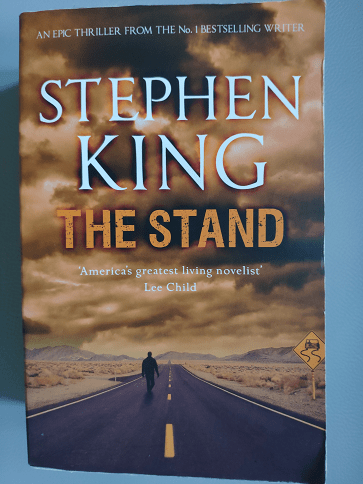
If you’ve heard of The Stand, chances are you’ll have heard two things about it. One, that it’s Stephen King’s masterpiece. Two, that it’s longer than a snake’s sock. The latter is definitely true, and the former is probably mostly true.
King has a main cast you couldn’t count on one hand, even if you live near a nuclear waste dump, and they all have an in-depth story that individually are the lengths of normal novels. This gives the book a tremendous level of depth, but also potentially a degree of bloat. You don’t ever lose track of what’s going on, but the sheer effort spent getting to the endgame creates an impossible pressure for it to resolve everything stupendously, which no author could fully do. King gets most of the way there, but I did find the end a little lacking.
But The Stand is so much more about the journey than the destination, so if you’re in the mood for a good, long read, and your book-holding biceps are in decent shape, definitely get on The Stand train.
Review (i.e. there’s no business like spoiler business)
Captain Tripps is a brilliant name for a disease. It’d also make an excellent Beefheart-style band. That’s not particularly pertinent to this review, but I just wanted to get it out of the way.
As mentioned above, King spends a lot of time inhabiting his characters, making them real. Giving them full backstories, detailed thoughts and personalities, individual journeys. The Stand feels like a book where King thought every character here needs to be real and took it to the extreme.
Take Lloyd Henreid, for example. It would be the easiest thing in the world for King to just assign Flagg a loyal henchman. But he goes deeper, exploring why Henreid is so drawn to his authority, how Flagg emotionally manipulates him to create dependency, the forces that keep Henreid loyal to Flagg even as the Dark Man’s ship begins to lose its rats. It adds literal weight to the book, yes, but also emotional weight that makes it so much more satisfying to live inside.
King purportedly wanted to create something with the scale and power of The Lord of the Rings, and like the guilty little bookworm I am, I’ll confess now to never making it through J.R.R. Tolkien’s giant book-rock. Too many unpronounceable names, too many boring battles, too much investment to make in backstory and world-building. For that reason, I was a little worried going into The Stand that I’d never make it through and would be left adrift in a sea of words with a small raft and a dullard’s brain. But King’s epic manages to avoid all the issues I spanged into with LOTR, and replaces them with careful characterisaton, a heavy foreboding that pulls you forward and, of course, loads of wicked descriptions of people filling up with mucus and dying spectacularly.
It’s a tale of “dark Christianity” in King’s own words, but what feels interesting to me is that the two surviving tranches of Americans (this is very America-focused, I have no idea whether in the UK everybody skipped the whole post-apocalyptic showdown thing and baked a massive fucking cake instead) aren’t simply divided into ‘good’ and ‘evil’. And of course, how could they be? People are far more complicated than that. The Trashcan Man, for example, is drawn to Flagg’s camp and is almost his star pupil – a man for whom fire, explosions and destruction are practically a fetish. On paper, a Flagg man. And yet – he was a good kid bullied into becoming something broken. Is that a sign of being on the side of evil? And of course, he is actually the executor of God’s final winning blow in this particular battle. So is he a Flaggite or an Abigailee? Like Harold, and Nadine – and most of the characters – he’s both.
I think that is this book’s greatest strength and flaw. The separation of people into two camps, one about construction and the other about destruction, feels like it works on an archetypal level. But when you actually get into the detail of that, it feels much muddier, like getting right up close to a Pointillist painting and realising it’s only bloody coloured dots after all.
It’s a great book, but you do feel the length after a time (fnar fnar). The sheer amount of detail in it is its greatest strength and weakness. But if you have a few weeks to spare and you want to get into the guts of an extremely absorbing story of Good ‘n’ Evil ‘n’ That, definitely give this a go.
 Read Everything By