Rating: 3.5 underage rural psychopaths out of 5
Buy Night Shift on Amazon here.
Buy Night Shift from Bookshop.org here.
Preview (i.e. no spoilers)
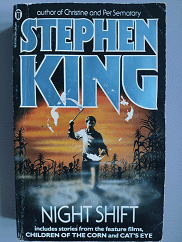
Night Shift is King’s first published book of short stories, which means two things: firstly, he had a lot to choose from, considering he’d been writing stories for over a decade at this point. Secondly, they don’t necessarily represent him at his peak. The result is a set of really strong stories that nonetheless aren’t King at his very best.
What’s fascinating is to see him play with some concepts that ended up in full-scale novels. Night Surf is a first run at the world of The Stand, and both Jerusalem’s Lot and One for the Road are similarly for ‘Salem’s Lot. The neat thing is that neither contradicts their later novels (or requires you to read them first) – they work nicely as companion pieces, chips off the old blocks.
Mostly, though, these are good, old fashioned genre short stories – i.e. he’s had a single, strong idea, built a narrative around it, and they all have a beginning, middle and end, thank God. In my weakling and pathetic opinion, there’s little worse than a story (short or otherwise) that is meant to function as a ‘snapshot of time’, or to ‘create a flavour’. Give me a plot or get off the pot. T-shirts with this slogan soon to be available.
It has a couple of weak spots, as is traditional in all short story collections, but remarkably few. The reason this is 3.5/5 rather than higher is that King, at his best, melds a gripping plot with uncomfortable home truths, and mostly these stories forgo the latter. I want to give myself room for higher marks in later collections.
Review (i.e. served with a side-salad of spoilers)
Okay. Strap in. We’re gonna hit this story-by-story, so huff on your reading glasses and get ‘em shining.
Jerusalem’s Lot
This functions as a really nice companion piece to ‘Salem’s Lot, but I’m glad it’s not actually part of the book itself. It’s not a spoiler to say that in ‘Salem’s Lot King is exploring the idea of small towns hosting their own particular brand of evil, and the big reveal of this story (that the town is built on top of a Lovecraftian worm monster) undermines that a little. But the story is creepy and (appropriately for a ‘Salem’s Lot relation) feels a little like Dracula in its old timey epistolary format. Effective atmosphere-building.
Graveyard Shift
I knew King had read a lot of Dean Koontz in his early storywriting days, and I did wonder whether this took some inspiration from Trapped (a not-very-good Koontz story), but this actually predates both Trapped and James Herbert’s The Rats – so now I wonder whether that inspiration flowed the other way. In any case, it’s a decent story that’s really no deeper than the premise – imagine a lot of massive, mutating underground rats, go on, just bloody imagine it – but it’s effective at doing that.
Night Surf
This functions as a precursor to The Stand, one of King’s great bloody barbells of a book, and it’s quite fun. It’s sort of an exercise in using unlikeable characters, and the biggest feeling I came away with was that disease is indiscriminate, and if 99% of us were wiped out by a big old virus cough cough, there’s absolutely no guarantee that the remainders of humanity wouldn’t be dickheads.
I Am the Doorway
Oof, this takes me back to a time of proper Old School Science Fiction Horror Stories. It’s got an edge of Ray Bradbury, Larry Niven and Arthur C. Clarke, but obviously King makes it his own too. Again, this is a good and functional story. The plot goes from A to B to horrifying C and that’s it – you’re not left with any big questions to ponder, but it’s a fun ride.
The Mangler
Setting up a lifetime of okay but now what if THIS were possessed/haunted/evil (insert everyday object here; house, hotel, car, mobile phone, Coke machine etc. here), the spookified subject this time is a great big laundry mangler with a taste for blood. King does somehow have an ability to make you suspend your disbelief and/or mental mockery in these types of story, and make something that sounds a bit ridiculous when summarised – imagine laundry equipment that’s possessed by a demon – actually feel creepy and very readable. Nicely executed.
The Boogeyman
I wasn’t particularly taken with this story – although the main character felt believable enough, and the cowardly sacrifice of his baby son was a nice touch – because it just felt a little too… on-the-nose. I feel like King could write a really good novel about The Boogeyman which expanded on the premise and gave it depth, but this just feels a bit like a campfire story, and the twist at the end is a bit silly, taking you out of the atmosphere he’s hewn.
Gray Matter
The setting for this feels familiar to the petrol station set-up in The Stand and One For the Road later in this very collection – a bunch of locals are all sitting about, shooting the shit when something breaks into their world and changes it forever. I did wonder whether King wrote this as a sort of tester for that part of The Stand, since he does seem to use short stories to explore ideas he later expands into full novels. Anyway, enough navel-gazing: this is nicely and creepily done. It’s sort of The Blob but with more beer and visceral stink.
Battleground
A silly and fun one, I really enjoyed Battleground. It’s hard to believe that the film Small Soldiers didn’t take some inspiration from it, either in this form or from the Nightmares and Dreamscapes TV show. King quite regularly takes something innocuous that seems far too small or gentle to do you any harm, and twists it into something deadly – this story is the epitome of that style.
Trucks
This is an odd one. I like it, but I’m not totally sure why. I think the downbeat ending is a big part of it – the hope that we could just outlast a crippling threat to humanity just by waiting is shot down – so it leaves a slightly odd taste in the mouth, but you nonetheless feel like you’ve eaten something substantial. Not my favourite in the book, but it is well done.
Sometimes They Come Back
Conversely, this one probably was my favourite in the book. A creeping evil, shocking brutality and satisfying ending all combine to make this an absolute A-grade winner. Is there anything scarier, when you’re a kid, than a gang of violent-looking teenagers? No, there is not. I think King must have encountered some pretty nasty bullies when he was a youngun, because this is a character type who recurs in a lot of his stories – IT and The Body being just two examples. But it’s fucking powerful, which is probably why they keep cropping up.
Strawberry Spring
This is okay, but it felt a bit paint-by-numbers. A serial killin’, you say? An unreliable narrator with lapses of memory, is it? I’m sure there’s no way this will shake out predictably. It’s fine, as a short story, but I’d say a little unremarkable. By which I mean, obviously, still a hell of a lot better than I could ever do.
The Ledge
This is a pretty neat story; another example of King having one clear idea and then padding a plot around it. Who hasn’t looked out at one of those ledges that architects seem to whack onto buildings willy-nilly and thought I wonder if I could stand on that? King takes that and runs with it, and is a master of suspense while doing so.
The Lawnmower Man
It’s hard to believe the gall of New Line Cinema in pretending their film had even the slightest resemblance to this story. They’re as different as a glass of water and a grenade. This is a slightly silly story but no less enjoyable for it. The gross-out imagery is neat, and it does what it set out to do effectively and quickly. Personal favourite moment: When the eponymous Lawnmower Man munches up the obliterated mole along with all the grass cuttings. Grim and great.
Quitters, Inc.
This feels almost like a Philip K. Dick story, with its we’re always watching you suspense. Barring a small element of disbelief that can’t quite be suspended – I really doubt that his wife would be so totally fine with her own life and her son’s life being placed on the line to help the protagonist quit smoking, particularly after she’s been subjected to electric shocks – this is a really fun and absorbing tale. It feels more Bachman than King, but that’s no bad thing in a short story, I think.
I Know What You Need
Women, eh? goes the old sexist trope, they want us to be bloody mind-readers, dunthey? King does a nice job of knocking that on the head by looking at how that would really play out. It’s a pretty straightforward thriller, but a snappy and fun read.
Children of the Corn
When a character starts a Stephen King short story just itching to hit his wife, it’s generally a pretty good indication that he’s not going to survive. King doesn’t let us down here. The thing I really liked about this is that it felt like King had a very clear idea of exactly how the kids ousted the adults and led their inbred little society for years after, but he doesn’t go into that detail. It means all the confusing elements of the situation hang together even if we don’t understand them in full. It feels real and full. I’m also retroactively impressed with how well the film captured the atmosphere he designed here.
The Last Rung on the Ladder
This is a sad little story, full of pathos and that sense of vague loss that I think we all experience as our relationships shift and our priorities mutate. Nostalgia for simpler times, straightforward love and the sense of meeting all your relationship obligations is shot through this story. It’s very good, if leaving you feeling a little emptier at the end of it.
The Man Who Loved Flowers
Another fairly paint-by-numbers affair. It’s very well written – the suffuse of apparent love that is obviously to every stranger on the street is really expertly done. But ultimately the build-up makes it very clear that there’s going to be a twist, and when it comes it’s not surprising or shocking, it’s just there. Not a bad story, just nothing too special.
One for the Road
Another in the ‘Salem’s Lot extended family. It actually feels like a deleted scene from that book as much as anything, but it is self-contained and works as a post-script nicely (although ironically I think it was actually written before ‘Salem’s Lot). Bonus marks for an evil little girl monster. You can’t go wrong with an evil little girl monster.
The Woman in the Room
Another sad story, rather than a thriller or horror. King peels back the layers of the protagonist’s situation with the skill of a pro-chef picking muddy layers off a leek. The ending is inevitable from very early on, but the journey to get there is the point of the story. It asks hard questions, like: if you’re euthanising someone, how much of that is about them, and how much is about you? If you can’t stand to see someone in pain, is that not still more about your reaction than their pain? It’s a well-written think-piece and I liked it.
 Read Everything By
2 thoughts on “Night Shift (1978)”