Rating: 3-out-of-5 bloodsucking monstermen.
Buy ‘Salem’s Lot from Amazon here.
Buy ‘Salem’s Lot from Bookshop.org here.
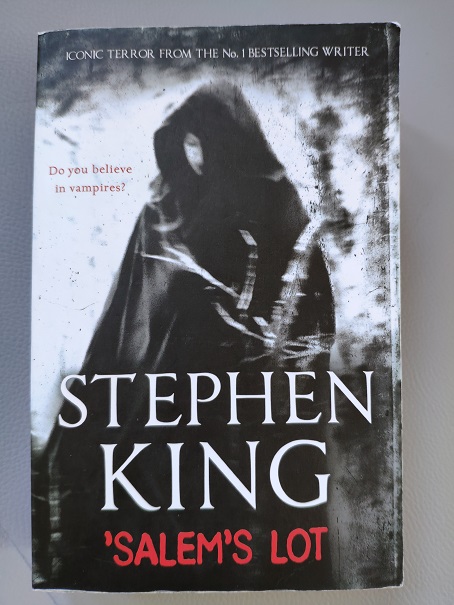
Preview (i.e. no spoilers):
‘Salem’s Lot is a good ol’ vampire story, although as always, there are deeper layers of personal and societal introspection buttering that toothy toast. Vampire stories are sometimes said to reflect our primal fear of infection, and the pace of this novel reflects the speed of a pandemic – incredibly slow to start, and a race by the finish. In many ways this is core King at his best… but be prepared to read a lot to get to that.
Review (i.e. Spoiler Bloody City):
I said in my previous Carrie (1974) review that I didn’t really get why King was said to write horror – that he focused on the darker elements of our inner workings rather than creating horror, per se. Then, of course, the very next book I read is all about bloody vampires, and cocks such a snook at my theory that my snook will remain firmly cocked up for months. This is horror in the truest sense of the word.
‘Salem’s Lot was published in 1975, which means it came after the Hammer Horror years had played around and more firmly established a lot of the lore, but before vampire lore came to be really overplayed out. Being a product of its time means that quite a few of the establishing vampire lead-up moments (the human ‘familiar’ buying up estate; the shipping of curiously coffinesque boxes; the odd stranger needing to be invited in, etc.) can feel a bit run-of-the-mill, because they’ve been drawn upon so much in recent years. But King sticks to them effectively, and once they’re established, you discover that King’s vampires have bite – if you’ll excuse the pun (and, let’s be honest, even if you won’t).
These vampires are raw, and bloody. As King himself notes in his afterword, they take the elegant nobility of Barlow (King’s stand-in for Dracula) and fuse it with a brutal, animalistic monster that shreds as much as it bites. He manages to inject fresh blood (this was always going to happen and you only have yourselves to blame) into the dusty old veins of vampire stories. There’s a real sense of threat, particular as the numbers multiply.
As I’ve previously said though, a lot of the depth of King’s work comes from the darkness of humans rather than bitey monsters. He makes this explicit in the world-weariness of Father Callahan – who longs to have capital-E-Evil to fight, with its black-and-white simplicity, rather than lowercase-evil, which is imbued with the sadness and sickness of humans, complex and unkillable.
This is the stuff in the novel that made me genuinely uncomfortable, and had the most horrific elements, for me. The let’s-go-on-a-vampire-hunt section is pacey, and fun, and contains horror, but the build up that reveals the scale of the town’s backdrop of everyday human evil – the man who beats his wife, the mother who beats her baby, the bus driver who loathes his fares – feel far more unsettling. It’s a really effective way to say this town is sick before a lengthened canine tooth is anywhere near poking into view.
Unfortunately, for me, that slow-burn build is also one of the aspects of the novel that I found most frustrating. Carrie wasn’t a perfect novel, but it contains exactly everything it needs and no more.
While I genuinely usually like the way that King throws more flavour into the pot with extra details or characters, in this case it felt like the first third of the novel needed some fat trimming. You can create the pathetic fallacy without pages and pages of descriptions about Maine’s weather. It stands in stark opposition to Carrie in that way. But let’s be fair – this is his second published novel, so if the this is too fat, and his first too lean, I can absolutely forgive both, because the strengths vastly outweigh the weaknesses.
It’s a great, solid vampire novel with more to say about the quarry than the hunter, like Deer Hunter Monthly written by a stag.
 Read Everything By
One thought on “‘Salem’s Lot (1975)”