
Rating: 4 bloody Christs-on-the-cross out of 5
Buy Carrie from Bookshop.org here.
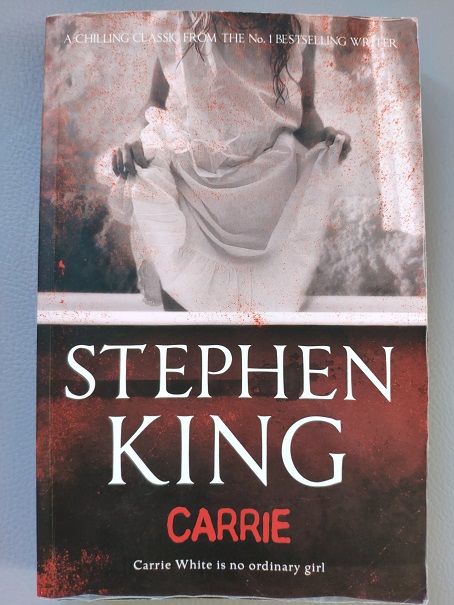
Preview (i.e. no spoilers):
This is vintage King. Slightly before he’s in his full element and found his signature style, it nonetheless touches on some key subjects and themes that will spookily haunt, woooo his oeuvre like so many lingering Maine ghosts. So paranormal abilities, religion, coming of age, the cruelty of people (specifically children/teenagers) – it all gets set up here.
It’s also pacy. King is often accused (sometimes fairly) of bloating up his books like beached whales, but this is sharp, fast and short. There are really only two key events in it, with other smaller scenes revolving around them. If you want to get into King but you’re put off by the Biblical length of The Stand or It, you could get through Carrie in a day.
It’s a brutal, sad and gripping story, from a writer on the ascent towards the top of his game.
Review (spoilers ahoy!):
One thing I often mull over with Stephen King books is how they get labelled as horror. And I guess they are – they’re full of unnatural deaths, monsters and ghosts. But horror feels like such a diminutive way to describe them, like calling music a bunch of sounds, or the brain a jelly-rock. They’re full of tension, and contain elements that bleed well into horror, which is why so many horror films and TV series have been made off the back of them.
But those elements aren’t the point of the books, in the way that they so unfortunately often are with those adaptations. The point of the books is to explore people as wholes, including the things we feel uncomfortable acknowledging: the dark impulses and thoughts we have but quash, emotional whack-a-moles that pop up at the most inconvenient times; the people, things and ideas we cling to as we try to make sense of a world and events that often feel senseless.
The point of the books is also to give the reader a good time – or at least, a breathless one – while doing that. It’s the literary equivalent of asthma.
Carrie encapsulates these aims perfectly for me. On the one hand, it has the ferocious speed of any paperback thriller or hard-boiled tale you can pick up from one of those weird spinny cages that shops use to say sure, these are books, but they’re not real books. We wouldn’t dream of putting them on actual shelves.
On the other, it uses that speed and exciting set-pieces to deliver some very bloody uncomfortable home truths about us as people. Thanks a bunch, Stephen King. Thanks for making me feel things, ugh.
For me, the hardest message to swallow – the one that haunts Sue Snell throughout the book, but also Carrie’s gym teacher, Ms. Dejardin – is our instinctual rejection of people marked out as weak. It’s awful and has no place in civilisation. But like a Lego brick on a floor in a dark room, it lies patiently waiting for us to stumble onto it when we least expect it.
I think it’s important to distinguish the victim label from being an actual victim. People are victims of terrible things all the time – both manmade and natural. But what I’m talking about here is the victim mentality a group imposes on an individual for no reason other than them being themselves. Carrie White is the chosen victim-and-pariah in one in her every social interaction. She is quiet, sad, overweight. Her schoolmates tar her with the brush of her mother’s maniacal religiosity; her mother does the same with that of her connection to the wider world and her supernatural abilities. Both serve to make her outsider.
I remember a girl from my own secondary school, whom I’ll call Zara for no good reason other than it’s not her real name and anything with a Z in still feels space-age and Buck Rogersy to me. Zara was weird, to us. She was quiet, and would cry at odd things. She would get under her desk in the middle of a class and mew like a cat. Her eyes were circled with dark rims, like she never slept. She was very pale. I look back on Zara and hope she is well, and that she found her place. But at the time I remember my feelings about Zara were a mix of confusion, fear and disgust. She did nothing but be herself, but elements of that marked her out as different and – I remember thinking – wet, and although I think – hope – I was nice to her, that barrier stood between her and the rest of her class, preventing true connection.
I think back on that time with nothing but shame. I think if we’re honest, we’re all aware of a person in our lives we could feel similar shame around. And it’s that emotion that King is teasing out here, like an absolute word-twiddling bastard.
The way he looks at it is as sin. He’s drawing parallels between the total commitment to religion of Carrie’s mother, and the total commitment to the in-crowd mentality in, in this instance, high school. Carrie is deviant in both instances, with her mother and Chris Hargensen acting as High Priestesses of each respectively. And the sadness comes from the fact that Carrie has done nothing to contravene the codes of either – her sin is simply existing. Not unlike Marmite.
There’s a ton more I could talk about – the role of blood, the fact that she is a target because she’s a woman, the shakiness of the leadership statuses of Margaret White and Chris – but this is meant to be a review, not an English Literature essay. Suffice to say that, like someone desperately trying to zip up their holiday suitcase, King packs a hell of a lot into a small space. He does a lot with little, in contrast perhaps to some of his later works.
It’s not perfect, by any means – some of the epistolary extract stuff could have been lost in favour of his own, stronger narrative voice, and barely any female character goes without some description of her hair and breasts. “How could I possibly understand this woman’s motivations,” I think to myself in desperation, “without knowing whether she had a full bosom or natural blonde hair?! FEED ME, STEPHEN, FEED ME.”
But for that casual sexism, he is also intent on portraying the often-cruel lives of women in a whole way. There is, at least, a balance in place.
Overall, I give Carrie 4 out of 5. A great start!
 Read Everything By
One thought on “Carrie (1974)”